Being a good digital citizen means using technology in responsible, safe and legal ways.
The internet, and what we do with it has evolved so quickly that it is often hard to keep up. Because of how quickly technology evolves, parents sometimes have a hard time keeping up to what their children are learning and doing online.
Gone are the days of “calling on” their friends by ringing the doorbell. The reality is, our children are growing up in a digitally focused world, where they keep in touch and communicate with friends online. Youth are sharing and consuming mass amounts of data on the internet.
Children need to be taught how to function as productive online citizens in a safe and respectful manner, and how to process the information they are taking in.
In the classroom, appropriate use of the internet can be cultivated by hosting open discussions about the dangers of internet use, including the very real effects of cyber bullying, illegal downloading, and putting inappropriate content online.
Providing curriculum enhancing opportunities which allow students to engage with the internet appropriately will allow students to build a base of knowledge that can be extended upon as they grow and continue to contribute to the digital world.
In an elementary setting I may host group discussions and then have students contribute their critical thoughts to a blog post.
In a high school setting, blogging and tweeting are a great way to have students demonstrate the knowledge they have developed.
Creating videos, music and art through technology may also offer a creative and relevant outlet for students through which they can demonstrate their learning.
Having opportunities to contribute in healthy and critical ways to the digital world will allow students to see the appropriate ways in which they can get involved online – and hopefully this, combined with the knowledge provided to them about the dangers of the internet, will help them to grow into continually positive digital citizens.
When I first started taking EDTC 300, I was coming from an anti-technology in classrooms stance. My plan was to teach the basics of computers and their functions, with minimal iPad integration and that would be the end of tech’s role in my future classrooms.
Based on the number of hours that my teenager spends on her phone, and the number of times I’ve heard from teachers that their students are constantly distracted by cellphones, I still firmly believe that there is a time and a place for technology in a classroom, especially where social media is concerned.
In order to raise a generation of proactive and respectful digital citizens, I no longer believe that keeping my students separated from technology will benefit them.
Social media allows for an array of problems, from round the clock cyber-bullying, to the filming/photographing and sharing of private moments, inappropriate behaviour and the non-retractable sharing of opinions.
These problems are consistent themes in the lives of modern high school students. What can be accessed through the internet, and through the use of apps that are constantly being generated, is endless. It is our responsibility as teachers to educate our students on safe, healthy and productive uses of technology.
One of the problems that parents and teachers today face, is dealing with the unknown that comes with tech. We recently explored a bevy of cell phone apps which allow users to store and hide content on their phones, utilize apps that are not age appropriate or promote the sharing of explicit photos and conversation. Most parents know about apps like Snapchat which allow their teenager to send photos of anything knowing that they will be deleted within a certain time frame, giving youth a false sense of security. But apps have evolved beyond snap chat and having a basic understanding of what is out there will benefit anyone who has an influential role in the lives of youth.
With apps evolving daily and new apps becoming accessible on a regular basis, it’s hard for parents and teachers to keep a handle on how our youth are utilizing their technology.
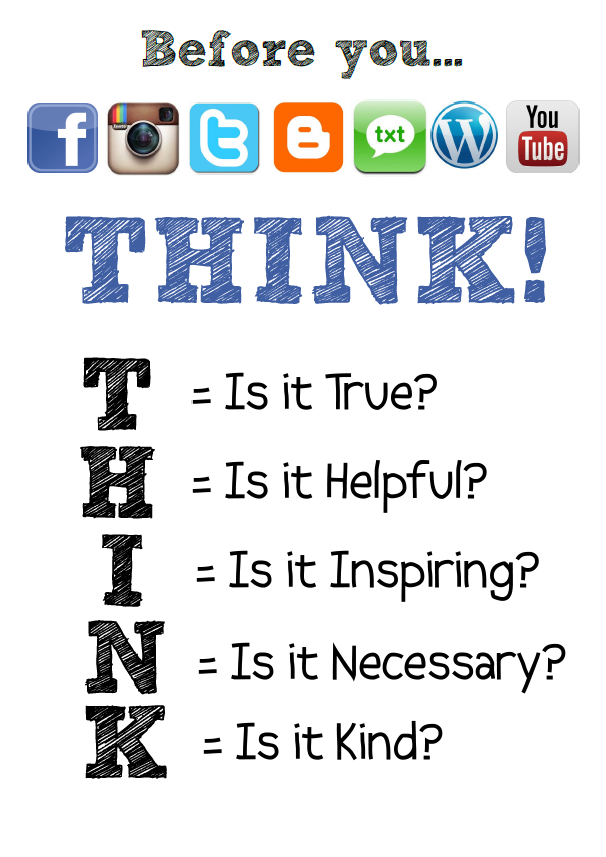
This, is precisely why I would teach my high school students (all students) how to contribute to the internet in healthy and positive ways, while engaging with social media in a highly critical way.
With this newly developed goal in mind, I believe I would allow social media into my classrooms, during the appropriate lessons with the objective of teaching my students how to enhance the world and their experiences online.
Twitter and blogging can be used effectively and in easy-to-monitor ways. These can be utilized as mediums through which students can demonstrate skills and knowledge, making them appropriate for a high school setting.
Video created by tenth graders who were learning about social media and critical engagement.
We’ve been assigned with what is probably the most exciting assignment I’ve received thus far in my first year of the YNTEP program.
The Independent Project, for which I independently decided on what I wanted to learn about, has been the perfect excuse for me to focus on something that I had been meaning to make time for.
There was a definite and positive shift in my attitude towards this student led assignment, which confirmed the value of the concept that students might actually get excited and become more engaged, if they are truly interested in what they are learning about.
Since moving to the Yukon, the most difficult transition for me has been where to find and how to utilize environmental supplies and programs – like recycling and composting. This is something that we had wanted to learn more about since our arrival!
As a family we decided to make some additional changes in our lifestyle. If it wasn’t particularly relevant to our family, we wanted to at least become aware of better ways to do things so that we could advocate for our planet.
I have created a blog called Us and the Environmenth that follows my children and I on our journey to do everyday things, in a greener way!
I’ve created a short video through Screencast-O-Matic about how to use the Google app, Google Classroom.
I have been looking at Google Classroom and exploring how, and why, I might use it or recommend it. I find google apps to be extremely user friendly. It took me very little time to figure out the ins and outs of Google Classroom. It reminds me of the functionality of the Moodle system that we use as students of Yukon College. I think that if you intend to use technology to communicate with students, that Google Classroom might be of great value. Google Classroom is also an awesome way to give parents the ability to stay up to date and engaged with what is going on in the classroom.
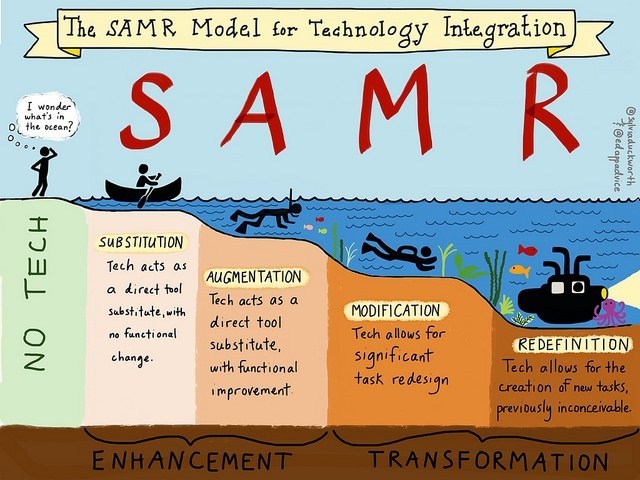
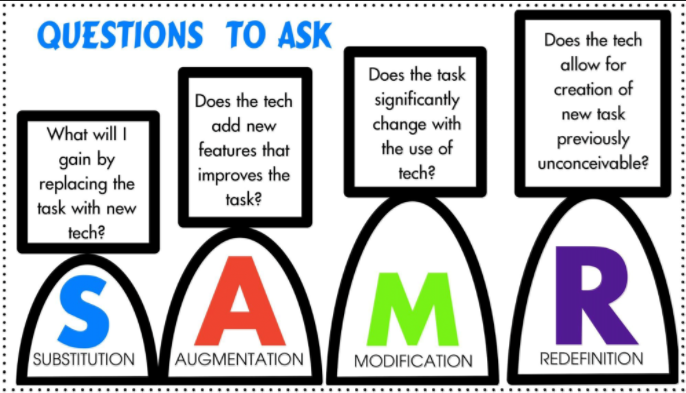
As per the SAMR matrix, Google Classroom is definitely a way to augment the way that we teach. It is a substitution for the to-do list and the daily take home note/ agenda. The app allows for modification to teaching in the sense that we can include videos and links directly into assingments.
The lid has been blown right off of what we are capable of doing in the class room when we utilize technology. The opportunities for tech usage are endless and range from the supplementary use of iPads for reading and test taking, to the wild and immersive world of virtual reality. In EDTC 300 this week we’re discussing the SAMR Matrix, which provides a fantastic visual for the levels upon which we can engage with technology to utilize it effectively. These levels include the substitution, augmentation, modification and redefinition of technology.
In looking at the SAMR Matrix, I am inspired thinking about all the ways I can integrate tech into my future teaching environment, and I question deeply how I will do it without compromising my own teaching philosophy. Finding harmony between constantly advancing technology and our goals as educators is paramount, especially where decolonization is concerned.
Most classrooms in North America utilize technology at the substitution and augmentation level, where they have introduced tablets and smart boards into the teaching tool box. Many teachers have also found inventive ways to utilize technology at the level of modification and redefinition.
Tech in the classroom can mean the difference between sitting at a desk working on math problems or getting blood pumping, being physically active and solving the same math problems on the wall of the gym, while engaging with classmates.
Math on the wall of the gym!
Technology has made it possible to learn new languages and skills without a human teacher. Video games and apps allow us to learn about different cultures, lifestyles and professions.
The opportunities are seemingly endless and will continue to expand and develop rapidly as the years pass. Now is the time for teachers to really begin thinking critically about the role that tech will play in their classroom and how they can align it to support their teaching goals. For us in Yukon, we must consider how we will align tech with the educational goals of the Yukon First Nations.
There are dangers that come with technology, and I’m not referring to the child predator disguised as a pre-teen girl on the other end of the chat room conversation… I’m talking about a simpler danger, and that is disengagement with the real world. Disengagement which takes us increasingly further away from the natural lifestyle that First Peoples once lived.
Vicky Rideout, a researcher from Common Sense Media in San Francisco has focused her attentions on media use by children and concluded that, “media use among children and teenagers ages 8 to 18 has grown so fast that they on average spend twice as much time with screens each year as they spend in school.” (Richtel, 2012).
Computer and cell phone screens support colonial goals in the sense that they further remove children from the traditional and holistic relationship to people, and to the land, which we as YNTEP students desire to enhance and promote.
With a great number of students having consistent access to technology outside of schools as well, we need to understand that the mediums in which they are learning best, or have become accustomed to learning through, will remain a part of their lives.
If shorter attention spans and enhanced stimulation are making it difficult to learn in the traditional setting, then we as teachers are responsible for accommodating our students learning needs and providing teachings that are relevant to them.
The challenges then become: 1) integrating technology that does not replace the teacher but enhances and supplements the teacher’s goals, 2) teaching our students how to develop a highly critical mindset and healthy digital literacy skills, and 3) maintaining and expanding upon personal relationships with the people and the natural world around us.
We are doing children a disservice when we do not ensure healthy balance in their lives. Healthy balance once meant getting enough sleep, enough exercise and eating well. In our modern world, a healthy balance is expanded to include getting enough real-world connection and not over indulging in technology.
As shown in the video above, where children are engaged with each other, learning, and having fun playing with technology, it is possible to teach in ways that are a win-win-win for children, their educators and the goals of decolonization.
Technology must not take children away from traditional values and healthy human contact. It must instead work harmoniously alongside the need to maintain relationships with people and the land. It is possible to design our teachings around nature and human contact and then to integrate technology effectively into those teachings. This is where educators must think critically about what lessons can be provided to students where technology will enhance the lesson and not simply replace it with additional, and sometimes unnecessary screen time.
We discussed in one of our classes last week that Socrates believed that writing would cheapen knowledge; that it would defer those utilizing the technology of writing from using and developing original thoughts and ideas. Could Socrates have foreseen the advent of the internet 400 years BC? The written word has changed the way we function as a society in immeasurable ways. Writing has allowed us to share and spread knowledge on a grand scale – allowing individuals from all walks of life to be exposed to information and education that they may never have come across without writing.
Neil Postman said it right when he wrote that “it is a mistake to suppose that any technological innovation has a one-sided effect. Every technology is both a burden and a blessing; not either-or, but this-and that” (Postman, 1993, p. 5).
I agree whole heartedly that technology is both a blessing and a curse. Where I can see the benefit of various forms of tech, and of the internet, I also see the zombie that my two, six and eleven year old’s become when they focus their time on mind numbing you-tube videos. Regardless of the content, (which can very quickly go from wholesome and sweet to terribly inappropriate) the constantly changing graphics, bright light, colours and array of sounds have their brains over-stimulated and have programmed them to desire entertainment that maintains the same level of stimulation. The idea of utilizing imaginative play becomes unpleasant to them after the internet has provided instantaneous jolts of satisfaction. I see the shift from technology-based play back to creative play becoming more and more difficult as my children encounter tech both inside and outside of the home. Through experience, I have learned that the ONLY remedy for this tech apocalypse is nature. Luckily, we live next door to an array of easily accessible walking and hiking trails. Yet even with the vast wilderness we are surrounded by in the Yukon, I am always shocked by the number of children who come through our home and tell us that they don’t go for walks outside… My kids are being raised as tree-huggers, as I was, and the fact that my two-year-old can hike just shy of five kilometers before asking to climb onto my shoulders is one of my greatest sources of pride! Seeing as even educational online resources such as ABCmouse.com leave my children starry eyed and void of appreciation for life’s simple pleasures, I am left terrified by technology… But what if we were utilizing the types of technology that stem from or can be used along side nature? What if instead of putting a tablet in their hands we taught them how to build shelter, how to build a fishing spear and how to catch their own food during a day on the land? What if we utilized modern technology, like cameras, to document our learnings and share them on a tech platform? I’d call that a successful, all encompassing, lesson.
I really appreciated a quote we looked at last week by Jean Baudrillard, “We live in a world where there is more and more information, and less and less meaning.” Technology in my classroom won’t be the mindless usage that we see so many kids engaged in now-a-days. It is my duty to teach the children in my life to engage critically with the internet and I intend to utilize tech to guide their learning in healthy and wholesome ways. This is exciting! We do not, after all, want to fulfil Postman’s prediction by becoming obsolete as teachers, like the black smith did with the advent of the automobile.
A few years ago, (while surfing the net) I stumbled across an innovative kindergarten program in Japan. The technology here is in the structure of the building itself! The roof top is an open circular track with rope nets that allow the children to engage with the trees. The classrooms are open to the outdoors, meaning that if the weather is nice, students learn in fresh air the whole day through. The TEDTalk about this outdoor school makes me wish we had something similar in the Yukon.
Today I came across a really cool augmented reality sandbox, which is yet another example of how technology can be used in the classroom without physically handing a child an iPad or laptop. The opportunities to utilize tech within the classroom are endless. It is a matter of discovering the methods of delivering new technology that work for our students to maximize their learning and joy.
Let him that would move the world, first move himself. – Socrates
References
Postman, N. (1993). Technopoly. New York, United States of America: Vintage Books, A Division of Random House, Inc.






 YNTEP EDTC 300