The lid has been blown right off of what we are capable of doing in the class room when we utilize technology. The opportunities for tech usage are endless and range from the supplementary use of iPads for reading and test taking, to the wild and immersive world of virtual reality. In EDTC 300 this week we’re discussing the SAMR Matrix, which provides a fantastic visual for the levels upon which we can engage with technology to utilize it effectively. These levels include the substitution, augmentation, modification and redefinition of technology.
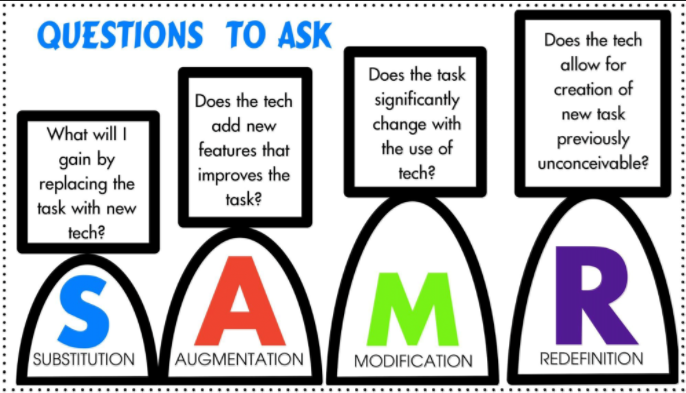
In looking at the SAMR Matrix, I am inspired thinking about all the ways I can integrate tech into my future teaching environment, and I question deeply how I will do it without compromising my own teaching philosophy. Finding harmony between constantly advancing technology and our goals as educators is paramount, especially where decolonization is concerned.
Most classrooms in North America utilize technology at the substitution and augmentation level, where they have introduced tablets and smart boards into the teaching tool box. Many teachers have also found inventive ways to utilize technology at the level of modification and redefinition.
Tech in the classroom can mean the difference between sitting at a desk working on math problems or getting blood pumping, being physically active and solving the same math problems on the wall of the gym, while engaging with classmates.
Technology has made it possible to learn new languages and skills without a human teacher. Video games and apps allow us to learn about different cultures, lifestyles and professions.
The opportunities are seemingly endless and will continue to expand and develop rapidly as the years pass. Now is the time for teachers to really begin thinking critically about the role that tech will play in their classroom and how they can align it to support their teaching goals. For us in Yukon, we must consider how we will align tech with the educational goals of the Yukon First Nations.
There are dangers that come with technology, and I’m not referring to the child predator disguised as a pre-teen girl on the other end of the chat room conversation… I’m talking about a simpler danger, and that is disengagement with the real world. Disengagement which takes us increasingly further away from the natural lifestyle that First Peoples once lived.
Vicky Rideout, a researcher from Common Sense Media in San Francisco has focused her attentions on media use by children and concluded that, “media use among children and teenagers ages 8 to 18 has grown so fast that they on average spend twice as much time with screens each year as they spend in school.” (Richtel, 2012).
Computer and cell phone screens support colonial goals in the sense that they further remove children from the traditional and holistic relationship to people, and to the land, which we as YNTEP students desire to enhance and promote.
With a great number of students having consistent access to technology outside of schools as well, we need to understand that the mediums in which they are learning best, or have become accustomed to learning through, will remain a part of their lives.
If shorter attention spans and enhanced stimulation are making it difficult to learn in the traditional setting, then we as teachers are responsible for accommodating our students learning needs and providing teachings that are relevant to them.
The challenges then become: 1) integrating technology that does not replace the teacher but enhances and supplements the teacher’s goals, 2) teaching our students how to develop a highly critical mindset and healthy digital literacy skills, and 3) maintaining and expanding upon personal relationships with the people and the natural world around us.

We are doing children a disservice when we do not ensure healthy balance in their lives. Healthy balance once meant getting enough sleep, enough exercise and eating well. In our modern world, a healthy balance is expanded to include getting enough real-world connection and not over indulging in technology.
As shown in the video above, where children are engaged with each other, learning, and having fun playing with technology, it is possible to teach in ways that are a win-win-win for children, their educators and the goals of decolonization.
Technology must not take children away from traditional values and healthy human contact. It must instead work harmoniously alongside the need to maintain relationships with people and the land. It is possible to design our teachings around nature and human contact and then to integrate technology effectively into those teachings. This is where educators must think critically about what lessons can be provided to students where technology will enhance the lesson and not simply replace it with additional, and sometimes unnecessary screen time.
References
Richtel, M. (2012). Technology Changing How Students Learn, Teachers Say. Retrieved from https://www.nytimes.com/2012/11/01/education/technology-is-changing-how-students-learn-teachers-say.html
(2018). Facebook video by Trista Murphy. Retrieved from https://www.facebook.com/trista.murphy/videos/950667284847/
 YNTEP EDTC 300